




About the Climate Change Agreement
A Climate change agreement (CCA) is a voluntary agreement containing targets to increase energy efficiency and reduce carbon dioxide (CO2) emissions. They form part of a package of UK government measures to respond to the challenges of climate change while helping the industry remain internationally competitive. Operators who commit to the scheme are entitled to a discount on the climate change levy (CCL) charge seen on their energy invoices.
| 1. Governing bodies | View now |
| 2. Climate Change Levy | View now |
| 3. Eligibility | View now |
| 3.1. Assess the CCA eligible energy | View now |
| 3.2. The 70% rule | View now |
| 4. Base year and Targets | View now |
| 1. Governing Bodies |
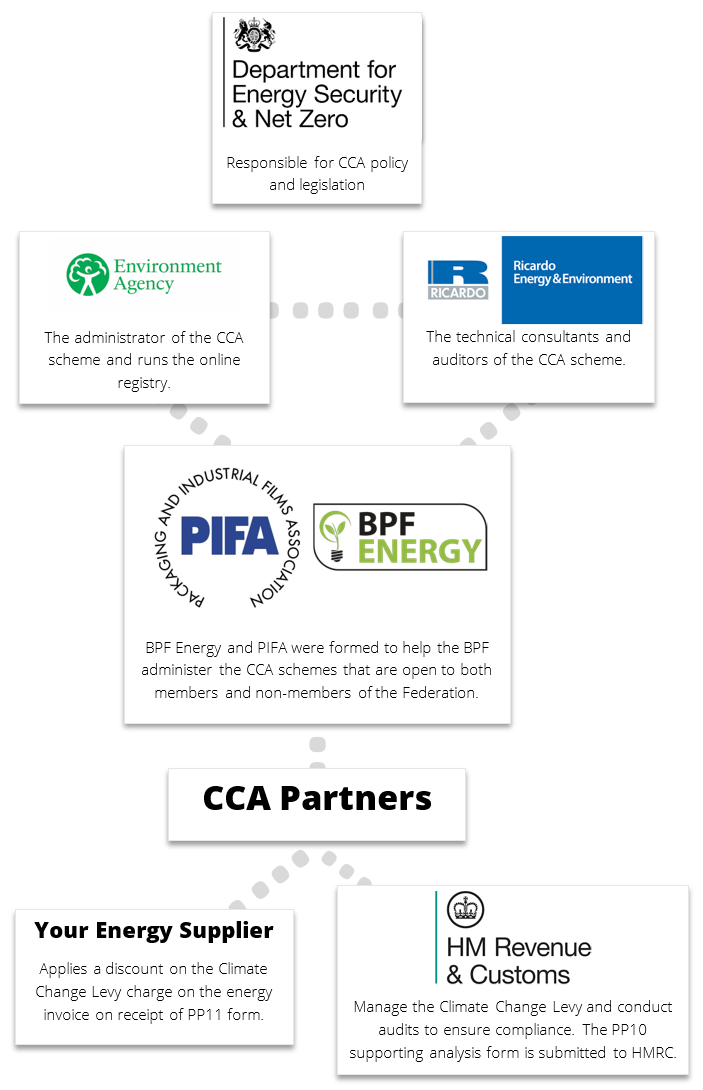
The set-up and maintenance of a CCA involves a number of governing bodies.
| 2. Climate Change Levy |
The Climate Change Levy (CCL) is an environmental tax charged on the energy used by businesses through the energy supplier. Energy intensive businesses can benefit from a reduced CCL charge if they choose to enter into a Climate Change Agreement (CCA), a scheme that is designed to encourage energy efficiency and to reduce carbon emissions.
The below table shows the Full CCL charge payable and discount availible for CCA participants.
Please swipe to the right on mobile to view the full table.
|
Taxable Commodity |
Rate from 1 April 2021 | Discount from 1 April 2021 | Rate from 1 April 2022 | Discount from 1 April 2022 | Rate from 1 April 2023 | Discount from 1 April 2023 | Rate from 1 April 2024 | Discount from 1 April 2024 | Rate from 1 April 2025 | Discount from 1 April 2025 | Rate from 1 April 2026 | Discount from 1 April 2026 |
| Electricity (£/kWh) | 0.00775 | 92% | 0.00775 | 92% | 0.00775 | 92% | 0.00775 | 92% | 0.00775 | 92% | 0.00801 | 92% |
| Natural Gas (£/kWh) | 0.00465 | 83% | 0.00568 | 86% | 0.00672 | 88% | 0.00775 | 89% | 0.00775 | 89% | 0.00801 | 89% |
| LPG (£/kg) | 0.02175 | 77% | 0.02175 | 77% | 0.02175 | 77% | 0.02175 | 77% | 0.02175 | 77% | 0.02175 | 77% |
| Others (solid fuels) (£/kg) | 0.03640 | 83% | 0.04449 | 86% | 0.05258 | 88% | 0.06064 | 89% | 0.06064 | 89% | 0.06264 | 89% |
For further detail on the Climate Change Levy please visit the Gov.UK site here
| 3. Eligibility |
The BPF manage two distinct CCA sectors, Packaging & Industrial Films (PIFA) and Plastics (BPF). To hold a CCA an operator must carry out one or more eligible processes.
PIFA CCA
For the purpose of the PIFA CCA scheme the eligible process refers to an installation or site where plastic film is produced using extrusion to convert melted polymer into blown or cast film: all processes and activities involved in the production of plastic film using extrusion to convert melted polymer into blown or cast film, and which may include printing using organic solvents in the following processes; lithography, flexography, gravure and screen printing on plastic film
BPF CCA
For the purpose of the BPF CCA scheme the eligible process refers to an installation or site where plastic materials, or plastic products (whether or not these are finished products), are produced by - (a) the application of heat and pressure to; or (b) a chemical reaction involving plastics powder, granules, shredded waste or liquid. The plastic processing techniques covered by this definition are:
- injection moulding
- reaction injection moulding
- compression moulding (including hot and cold press moulding)
- transfer moulding
- structural foam moulding
- direct screw transfer moulding
- rotational moulding (including slush moulding)
- flexible foam moulding (including dual component moulding)
- blow moulding
- casting
- expandable materials processing
- mixing and compounding
- calendering, powder coating (including dip moulding)
- sintering
- thermoforming (including vacuum forming)
- pultrusion
- filament winding
- spread coating
- hand lay-up and resin transfer moulding
| 3.1. Assess the CCA Eligible Energy |
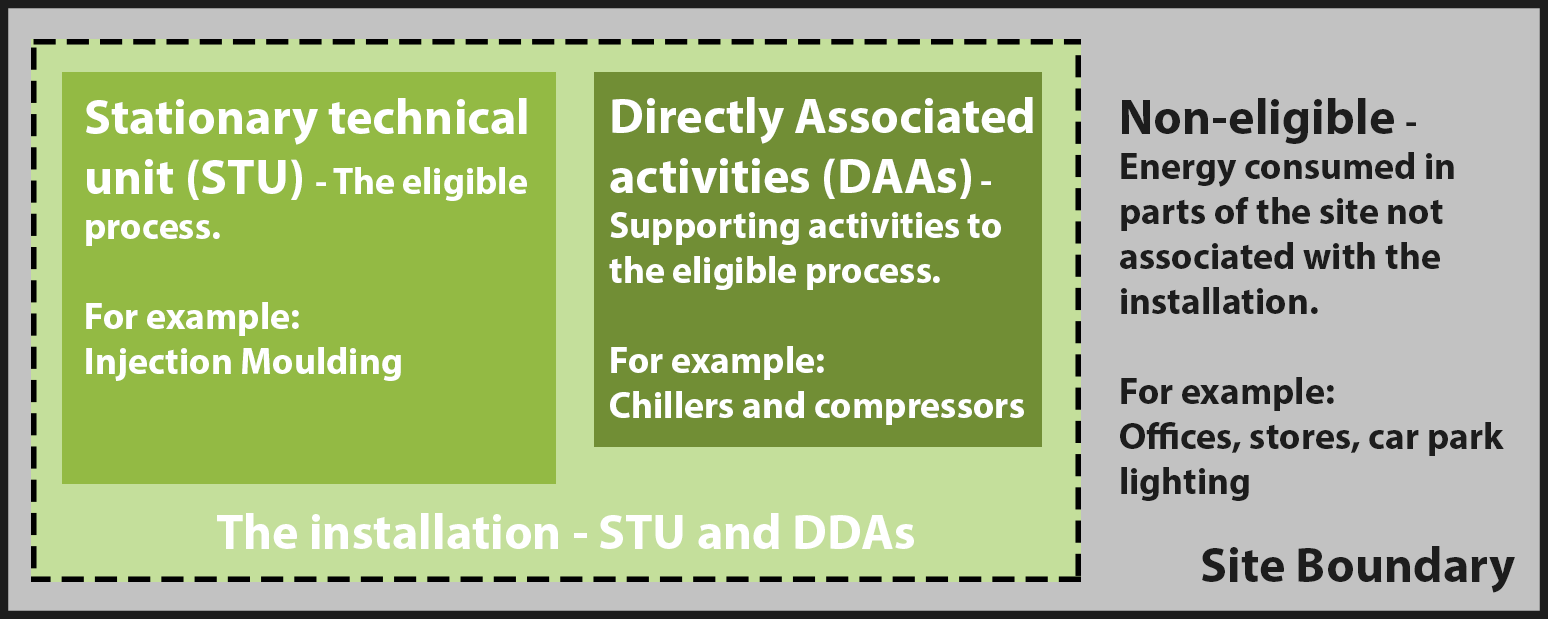
The energy consuming areas on the site should be identified under three categories:
- Stationary Technical Unit (STU) – The eligible process(s)
- Directly associated activities (DAAs) – Energy consumed by activities supporting the eligible process (compressors / chillers/ vacuum feeds/ lighting)
- Other activities – energy consumed in all areas not technically linked or supporting the eligible process, also know as non-eligible (offices, kitchen, store room)
| 3.2. The 70% rule |
The basic principles of the rule are as follows:
- If the installation (STU and DAA) consumes 70% or more of the site’s total energy, the site as a whole is deemed to be fully eligible.
- If the installation consumes less than 70% of the site’s total energy the site is allowed to claim up to an additional 3/7th of the installation’s eligible energy consumption as eligible. However the defined installation and any 3/7th addition must be sub-metered.
For further detail please contact 020 7457 5026 / 020 7457 5027 or email [email protected]
| 4. Base year and Targets |
The base year is a continuous 12 months of energy consumption and throughput data. The data collected during the base year establishes the baseline from which the targets are set.
- The base year for Target Periods 1 - 4 in most cases covers the 12 months of 2008
- The base year for Target Period 5 (January 2021 - December 2022) and Target Period 6 (January - December 2024) is the 12 months of 2018
All participants of the CCA scheme have an efficiency improvement target set against the baseline, with the option to report using the standard relative energy target or a novem energy target.
A standard relative target considers all the energy consumed and production throughput for the site as a whole (for example there is one overall measure of kWh/tonne)
A novem target is used when the site produces two or more products or product groups which have very different energy intensities or where the current operation and or product mix has changed since the base year (in this case each product or product group has a defined kWh/tonne)
Operators who commit to a CCA are required to work towards an energy efficiency improvement target. For example, the Plastic sector improvement target for Target Period's 1 to 4 was 17%, this was set against a baseline of 2008 and split across the 4 target periods.
In the Spring 2020 budget a two year extension was announced for the CCA scheme resulting in a further target period 5 (2021-2022) with CCL relief entitlement granted to 30 June 2025. The Plastic sector improvement target for Target Period 5 was 3.797% set against a new 2018 baseline. In 2023 a further extension to the CCA scheme was confirmed resulting in a new 12-month target period 6 (2024), with eligible facilities entitled to a reduced CCL charge until 30 June 2027.
Where the target is not met, an operator can remain a participant in the scheme, through a CO2e buy-out mechanism to account for the difference between the target and actual performance, for Target Period 6 this is set at £25/tonne.
Plastic sector commitment (BPF CCA)
| TP1 2013-2014 |
TP2 2015-2016 |
TP3 2017-2018 |
TP4 2019-2020 |
TP5 2021-2022 |
TP6 2024 |
| 8.5% | 11.333% | 14.167% | 17% | 3.797% (BY 2018) | 7.100% (BY 2018) |
Packaging & Industrial Films sector commitment (PIFA CCA)
|
TP1 2013-2014 |
TP2 2015-2016 |
TP3 2017-2018 |
TP4 2019-2020 |
TP5 2021-2022 |
TP6 2024 |
| 2.9% | 3.933% | 4.917% | 5.9% | 4.068% (BY 2018) | 4.068% (BY 2018) |